SpamBot
Combines Gemini-assisted rule drafting with deterministic Android workflow execution for calls, SMS, notifications, DND, and temporary automations.
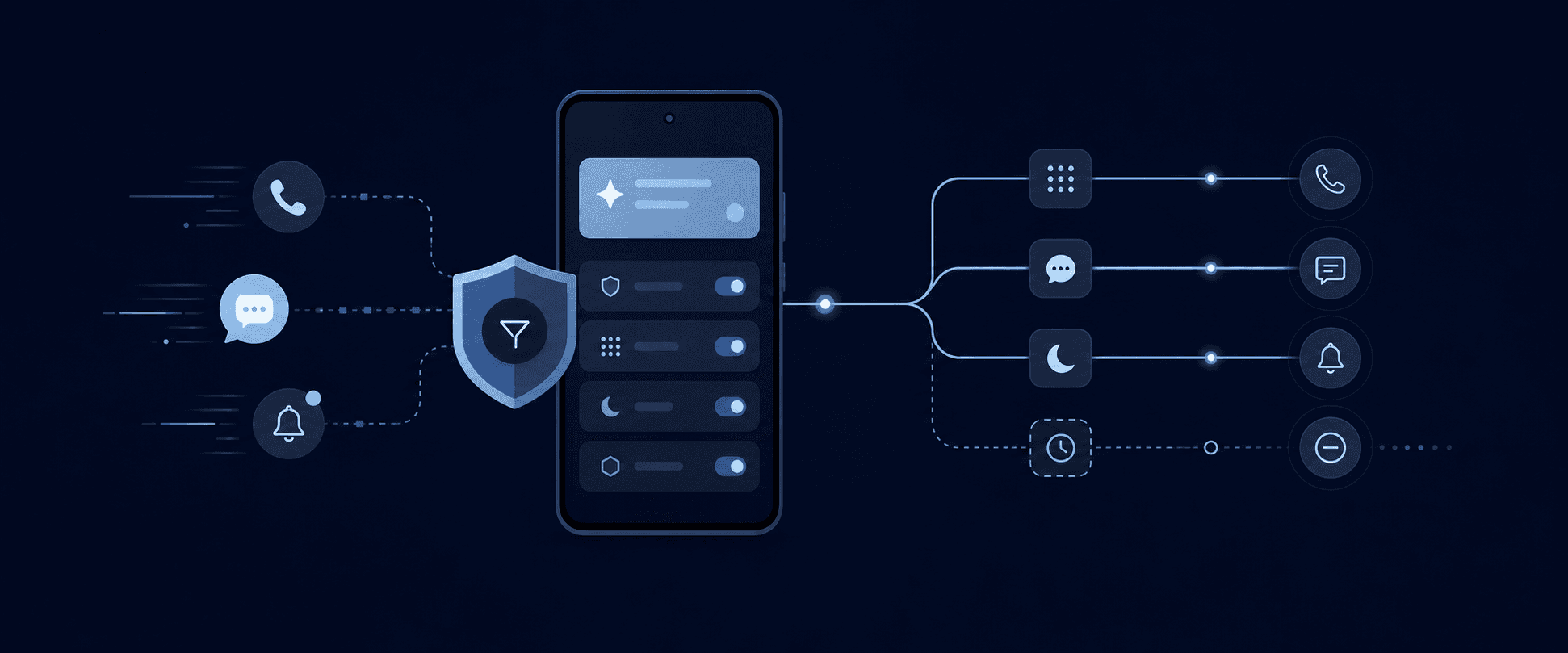
system visual
Protected or source media unavailable. Architecture preview used instead.
System Overview
Privacy-first Android automation and spam protection app that converts natural-language requests into telecom and device workflows.
Local Android product build.
Implementation Signals
System flow
A compact view of how inputs move through processing, orchestration, validation, and output.
Natural Language Request
Users describe rules such as spam blocking, auto-replies, or temporary device automation.
Gemini Rule Drafting
The assistant proposes structured workflow JSON and can verify contact names locally.
Conflict Detection
Exact duplicates, conflicting actions, and overlapping number prefixes are checked before activation.
Local Workflow Store
Rules are saved locally through SharedPreferences and JSON serialization.
Call / SMS / Notification Events
Android receivers and services observe incoming telecom and notification events.
Workflow Engine
Matched rules execute actions such as reject call, silence, SMS reply, DND, camera, or recorder.
Engineering decisions
Decision Record
Separate AI proposal from deterministic execution
Problem: Mobile automation can be risky if model output directly executes without validation.
Approach: Use Gemini to draft workflow JSON, then parse, preview, conflict-check, and confirm rules before execution.
Tradeoff: Adds validation steps before automation runs.
Outcome: Keeps the AI layer useful while preserving predictable Android behavior.
Decision Record
Keep sensitive contact data local
Problem: Spam and telecom automation touches private phone numbers, contacts, and messages.
Approach: Use local contact lookup tooling and avoid sending raw private contact records to the cloud.
Tradeoff: Requires a local tool-calling boundary and more permission handling.
Outcome: Improves privacy posture while still enabling natural-language automation.
Decision Record
Treat conflict detection as core product logic
Problem: Automation rules can contradict each other or overlap in ways users do not notice.
Approach: Add a deterministic conflict detector for duplicate rules, same-trigger/different-action cases, and overlapping prefixes.
Tradeoff: More product logic beyond basic spam filtering.
Outcome: Makes the automation engine safer and more operator-friendly.
Results / Learnings
Architecture
README-backed Android automation engine with CallScreeningService, SmsReceiver, WorkflowEngine, WorkflowManager, and ConflictDetector.
Safety
Rules are previewed, conflict-checked, and stored locally before execution.
Automation
Supports call rejection/silencing, SMS auto-reply, DND/ringer changes, camera, recording, and temporary workflows.
Progressive depth
This page keeps the outcome and architecture visible first. Implementation stack, decisions, constraints, and media are available below so technical depth is opt-in rather than forced.
Adjacent systems
LearnAgent
Education ERP platform for managing students, faculty, projects, and academic workflows with a path toward AI-assisted operations.
Product: Centralized academic workflow management into one platform.
OpenApply Bot Workflow Engine
AI-powered job application workflow with profile memory, answer generation, ATS handling, and browser automation.
Capability: README-backed bulk application dispatch from selected jobs.
OpenProtected Enterprise AI Systems
NDA-safe system patterns for enterprise document automation, review, compliance, retrieval, and AI workflow orchestration.
Disclosure: Generalized due to enterprise NDA.
Open